
We are very pleased to share our new article “Modular Fabrication of Quantum-Dot–Plasmonic Metasurfaces for Tailored Optical Modes”, published in Small Structures.
This work represents an important step for Kingslab’s research on scalable nanophotonic architectures. At its core, the article explores how colloidal quantum dots, gold nanoparticles, quantum-dot waveguides, and thin gold films can be combined like modular building blocks to create metasurfaces with tailored optical modes. The study demonstrates a scalable fabrication strategy that integrates top-down patterning with bottom-up self-assembly, including laser interference lithography, template-assisted self-assembly, layer-by-layer deposition, and physical vapor deposition. The resulting centimeter-scale metasurfaces allow precise control over polarization-sensitive and angle-dependent optical resonances.
A central achievement of the work is the identification of metal-assisted hybrid guided-mode resonances, or MA-hGMRs, at near-normal incidence. These modes combine thin-metal confinement with plasmonic coupling, leading to enhanced directional photoluminescence from quantum dots. In the article, this concept is connected to nearly threefold photoluminescence enhancement and a quality factor of up to 18.6, providing practical design rules for future colloidal metasurfaces with tailored emission properties.
For Kingslab, this publication is particularly meaningful because it brings together several central themes of our research: colloidal self-assembly, photonic mode engineering, plasmonic–excitonic coupling, and scalable fabrication of functional optical materials. The modular concept also provides a useful framework for future applications in directional light emission, optical sensing, enhanced spectroscopy, and integrated photonic devices.
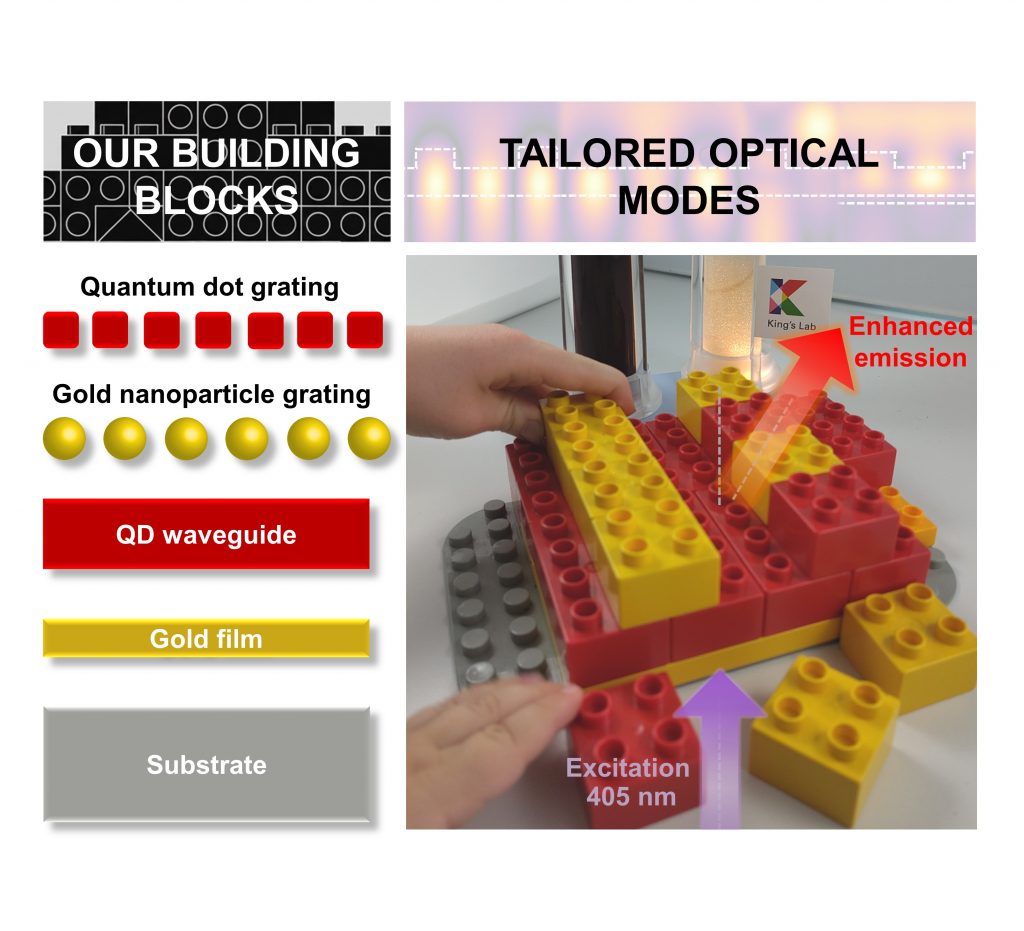
The graphical abstract illustrates this idea through a visual metaphor of color-coded building blocks representing colloidal quantum dots, gold nanoparticles, quantum-dot waveguides, thin gold films, and substrates. This modular photonic architecture highlights how bottom-up and top-down fabrication routes can be combined to generate tailored optical modes for optoelectronic applications.
Most importantly, this article is also a story about people. Sezer Seçkin played a central role in developing and connecting the experimental, conceptual, and optical aspects of this work. For Sezer, this study became one of the key pieces of his PhD thesis and an important contribution to the broader Kingslab vision of modular colloidal metasurfaces. We are also deeply grateful to Swagato Sarkar, whose expertise in guided-mode resonances, plasmonic–photonic coupling, and optical characterization was essential for shaping the scientific direction of the manuscript.
We would also like to sincerely thank our collaborators Gyusang Yi, Anatol Prudnikau, and Vladimir Lesnyak for their crucial contributions to the nanoparticle materials. Without their expertise and support in providing high-quality nanocrystals, this work would not have been possible. We further thank Anik Kumar Ghosh for his important help with characterization, which was essential for linking the fabricated structures to their optical response.
This publication is another important step in our effort to build scalable, modular, and optically active metasurfaces from colloidal building blocks—and to translate fundamental nanophotonic concepts into experimentally accessible material platforms.